
The Salt Lake Tribune Reporting | Warnings Have Continued for Decades, but Nothing Has Changed.


Two boarding schools on the Ute Tribe’s reservation failed to effectively educate Native students. And that legacy echoes in public schools today.
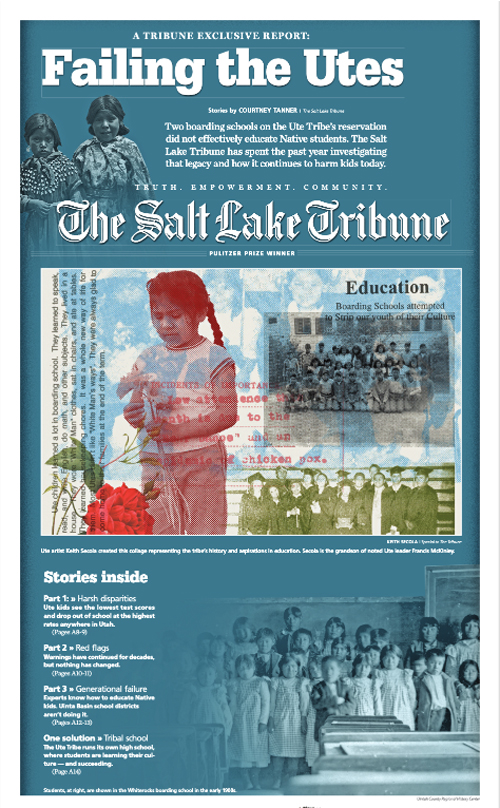
The front page of July 9, 2023 The Salt Lake Tribune
July 9, 2023
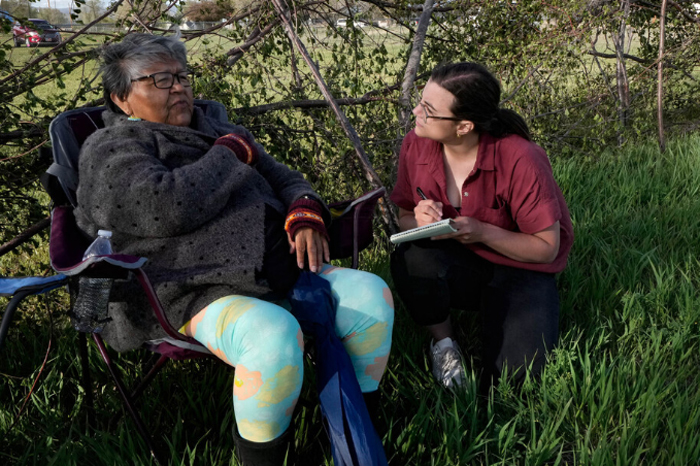
Francisco Kjolseth | The Salt Lake TribuneNancy Poowegup told Salt Lake Tribune reporter Courtney Tanner that her late mother was forced to attend the Indian boarding school in Whiterocks as a teenager and refused to talk much about what she experienced there. Poowegup wore a bright pair of blue and yellow beaded earrings to the Bear Dance in Whiterocks in May 2022 as a way to honor her.

Reporter Courtney Tanner examined hundreds of pages of records, from the boarding school era to the transition to public schools to recent grades, ACT scores and graduation rates in the Uintah and Duchesne school districts.

Those districts split the Uintah and Ouray Reservation in eastern Utah and serve about 800 Native students — largely Utes — between them.

Ute kids singularly fall behind in every metric and have for decades.

“There was never really a commitment to educate our kids,” said Forrest Cuch, a former education leader for the tribe. “Otherwise, we wouldn’t be seeing this pattern for so long.”

Here’s a breakdown of each part of The Tribune’s series and where to read them:

Part 1: The Ute Tribe’s kids have been failed by the public school system more than any other students in Utah

Ute kids see the lowest test scores and drop out of school at the highest rates in the state. Jayme Leyba, who oversees underrepresented student populations for the Uintah School District, acknowledged the shortcomings. “I wouldn’t blame people,” he said, “for being frustrated.” Duchesne County School District said it is “aware of the gaps in our system.”

The Ute Tribe’s kids have been failed by the public school system more than any other students in Utah.

Part 2: The warning signs were clear and repeated

Ute students started being left behind by the two boarding schools on the Uintah and Ouray Reservation — where white superintendents focused on labor over academics. Ute children later arrived less prepared in public schools, once they were allowed to attend, and were not able to catch up. One former tribal education leader thinks the failures in Utah’s education system are intentional.

Utah’s education system is failing Ute kids, and a former tribal education leader thinks that’s intentional.

Part 3: Experts know how to educate Native kids. Uinta Basin school districts aren’t doing it.

For the more than 70 years that Ute students have been languishing in public schools, leaders have also known what would help them succeed. It’s a paradox that Bryan Brayboy, a member of the Lumbee Tribe and director of Arizona State University’s Center for Indian Education, finds infuriating.

“Sometimes we forget that what we’re calling for isn’t actually new,” said Brayboy, who is also a professor of Indigenous education. “There’s a long history, a long list of studies that show if you can use culture in the classroom, that students can do really well.”

The Ute Tribe is trying to make up for the state’s education shortcomings, but resources are limited.

One solution: A public tribal charter school

The Ute Tribe runs its own high school, where students are learning their culture — and succeeding.

Popular posts from this blog

The Dispossessed: Cultural Genocide of the Mixed-Blood Utes, an Advocate's Chronicle

PDF DOWNLOAD AUDIO BOOK The Dispossessed: Cultural Genocide of the Mixed-Blood Utes, an Advocate's Chronicle. In this disturbing and provocative study, Salt Lake City attorney Parker M. Nielson chronicles the termination of the mixed-blood Utes from the Northern Ute Indian Tribe. He outlines how the termination process, initiated by Utah Senator Arthur V. Watkins, was visited on the Utes in a singular action by the U.S Congress and the Bureau of Indian Affairs, the only partial termination of any tribe in the nation. Termination for the mixedbloods meant loss of both tribal membership and any further claims upon the Bureau of Indian Affairs, similar to the impact of the termination policy upon other tribes in the 1950s. But for the mixed-blood terminated the losses went much further than being cut off from government assistance. Nielson, with first-hand information gained as legal representative for the terminated Utes, details how the separation of the terminees from tribal member...

Death of Utah Chiefs | Walker, Arapeen, Ammon, Peteetneet, Sanpitch, Kanosh, Tabby, Santaquin, Andrew Frank, Jim Atwine

  Deseret News | 1855-02-08 | Page 3 | Death of Indian Walker Deseret News | 1860-02-08 | Page 4 | Later from San Pete County Deseret News | 1860-12-19 | Page 1 | Death of Arapeen Deseret News | 1861-06-19 | Page 4 | Death of Ammon Deseret News | 1862-01-01 | Page 1 | Death of Peteetneet Deseret News | 1866-04-26 | Page 5 | Whites and Indians Killed Deseret News | 1866-05-10 | Page 5 | Home Items Killing of Sanpitch Deseret News | 1868-12-16 | Page 5  Deseret News | 1881-12-28 | Page 3 | Death of Kanosh Salt Lake Telegram | 1902-10-30 | Page 1 | Fifty Ponies Killed over Grave of Chief Tabby Deseret Evening News | 1902-11-03 | Page 7 | Fort Duchesne Salt Lake Tribune | 1902-11-23 | Page 6 | The Death of Chief Tabby Inter-Mountain Farmer | 1902-11-25 | Page 2 | The Death of Chief Tabby Wasatch Wave | 1902-10-31 | Page 3 | Chief Tabby Dead Spanish Fork Press | 1911-10-26 | Page 2 Roosevelt Standard | 1951-12-20 | Page 2 | Andrew Frank Vernal Express | 1951-12-27 | Page 1 | F...

Termination's Legacy: The Discarded Indians of Utah by R. Warren Metcalf

  Termination's Legacy: The Discarded Indians of Utah [PDF DOWNLOAD] Termination's Legacy: The Discarded Indians of Utah [AUDIO BOOK] Termination's Legacy describes how the federal policy of termination irrevocably affected the lives of a group of mixed-blood Ute Indians who made their home on the Uintah-Ouray Reservation in Utah. Following World War II many Native American communities were strongly encouraged to terminate their status as wards of the federal government and develop greater economic and political power for themselves. During this era, the rights of many Native communities came under siege, and the tribal status of some was terminated. Most of the terminated communities eventually regained tribal status and federal recognition in subsequent decades. But not all did. The mixed-blood Utes fell outside the formal categories of classification by the federal government, they did not meet the essentialist expectations of some officials of the Mormon Church, and th...