Records from the Uintah and Ouray Boarding Schools


screenshot of historic records

Records from the Uintah and Ouray Boarding Schools

These records include student enrollment and attendance reports, correspondence about employees, school schedules and more. They were obtained from the National Archives at Denver and Washington, D.C., by The Salt Lake Tribune.

School employees, 1889, 1902, 1903
Letters and reports about employees at Uintah and Ouray Boarding Schools
Go to index | Go to document
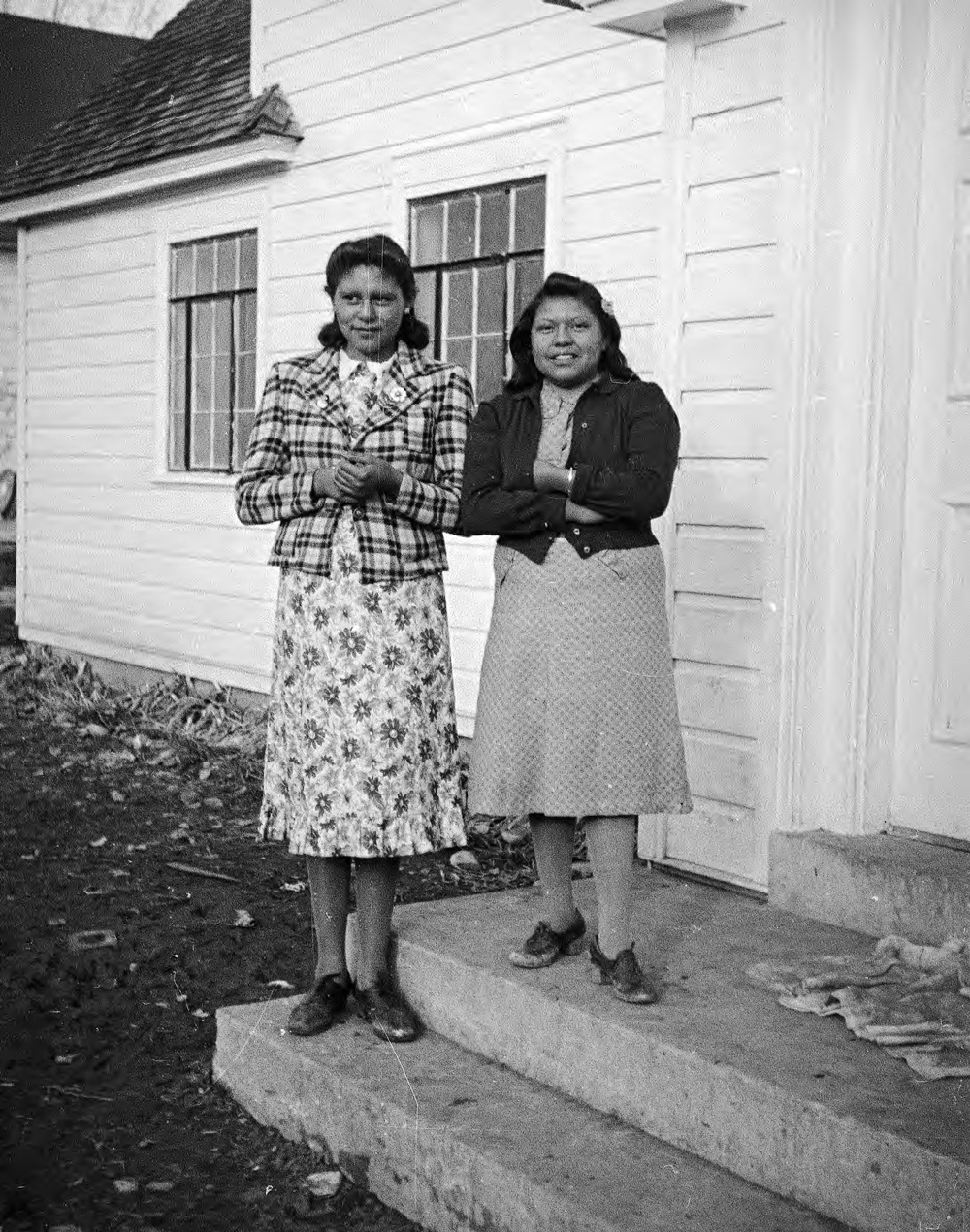
Two young women stand on a porch in this historic photo
Uintah County Library Regional History CenterNellie Ioupe and Marjorie Pigeon at Whiterocks Community Center in 1941. In 1934-35, they were students at the Uintah Day School in Whiterocks.

School employees, 1902, 1903
Letters about employees at Uintah and Ouray Boarding Schools, showing high turnover
Go to index | Go to document


Indian students in public schools, 1922
These are reports with lists of Ute students who attending Whiterocks, Dragon, Alterra, Randlett, Bennett, Duschesne River, Lapoint and Fort Duchesne public schools in periods ending in March and May 1922.
Go to index | Go to document


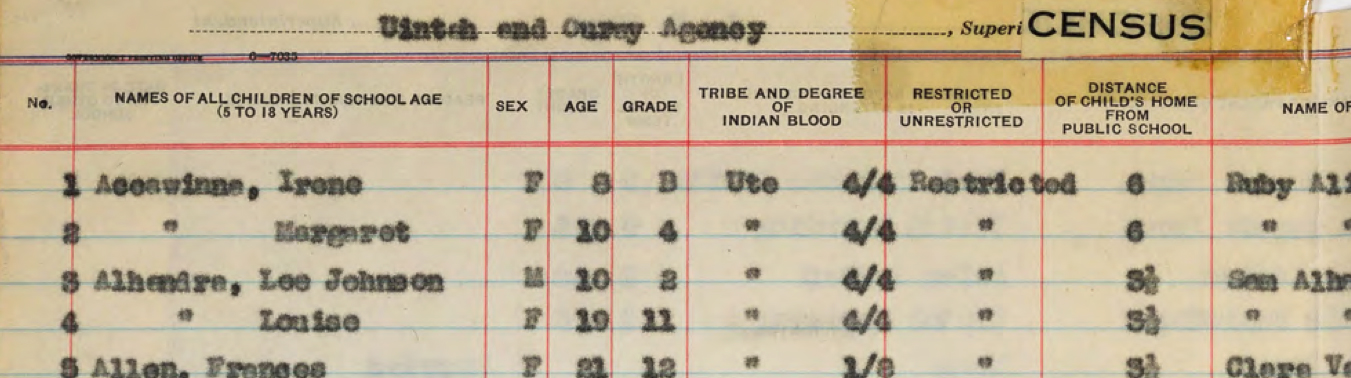
School census, 1934-1935
This document shows where Ute students were attending school in the 1934-35 school year. Some attended the Uintah Boarding School, some attended the day school there, and others attended various public schools. The index includes the names of parents.
Go to index | Go to document


Uintah Boarding School calendars, 1930s
These are calendars and schedules for the 1930-31 school year, the 1932-33 school year, and a special report created by Girls’ Adviser Grace E. Shively for the 1935-36 school year, which includes photos and a more personal look at the girl’s lives.

Read a story about these calendars — which includes an index at the end to the 1935-36 Adviser’s Report — here: Run on schedule: Inside the Uintah Boarding School in the 1930s

Download the 1930-31 calendar.

Download the 1932-33 calendar.

Download the 1935-36 Adviser’s Report.
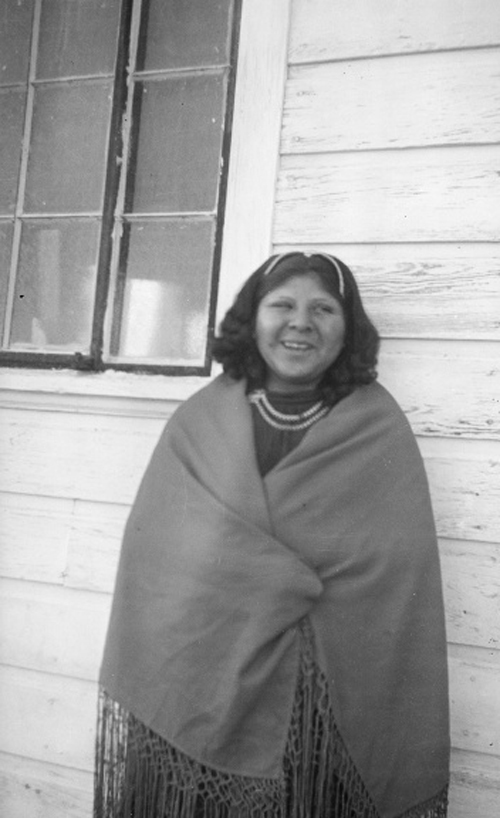

Black and white photo of Geanna Johnson wrapped in a blanket
Uintah County Library Regional History CenterGeanna Johnson at Whiterocks, undated. In the 1933-34 school year, she was attending the Uintah Day School.


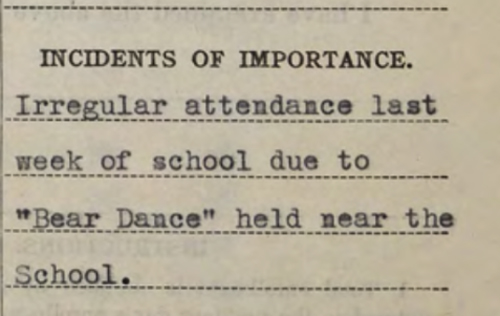
Note of irregular attendance
A note in the May 1934 monthly report from Uintah Boarding School

School census of Indian children, 1933-1934
This document shows where Ute students were attending school in the 1933-34 school year. Some attended the Uintah Boarding School, some attended the day school there, and others attended various public schools.
Go to index | Go to document


Uintah Boarding School monthly reports, September 1933-June 1934
In these reports, the school noted changes in attendance and significant events.
Go to index | Go to document


Uintah Boarding School list of students, December 1933
This document includes five pages of student names who were attending the Uintah Boarding School and one page listing students who had left.
Go to document>


Uintah Boarding School list of students, September 1934
This document lists 16 boys and 21 girls who were attending the school.
Go to document


Uintah Boarding School list of students, 1934-1935
This two-page document (the first page has the years mislabeled) lists 41 girls and 28 boys who attended the school during the year.
Go to document


Uintah Boarding School Roll, 1935-1936
This document includes lists of students by gender, each followed by individual records showing the student’s name, age, grade, parents and attendance.
Go to index | Go to document


Uintah Day School Quarterly Reports, 1936-1939
These documents are attendance records showing the number of children attending the Uintah Day School, which were classes offered at the Uintah Boarding School. The names of students who left school, and the reason, are listed.
Go to index | Go to document


Boys at Uintah Boarding School, 1936-1937
This document includes a list of boys at the school, followed by individual records showing each student’s name, age, grade, parents and attendance.
Go to the index | Go to the document
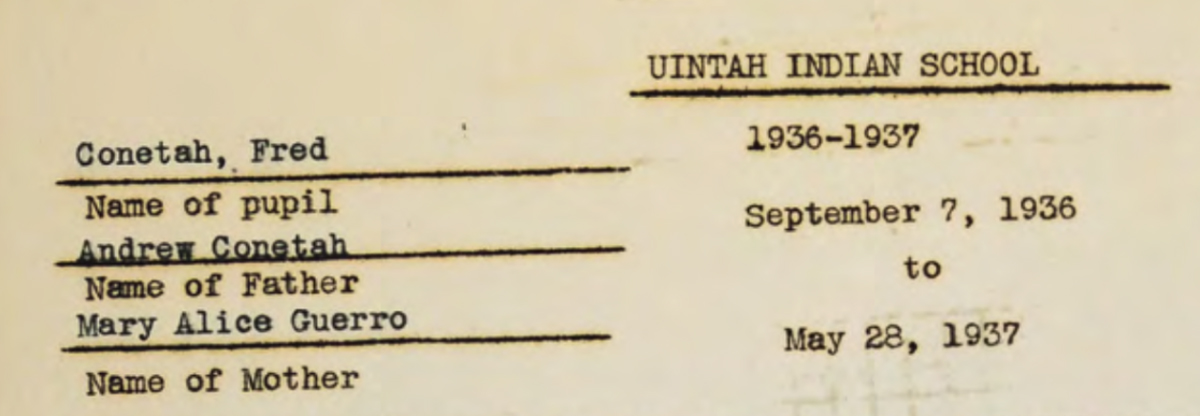

Girls at Uintah Boarding School, 1936-1937
This document includes a list of girls at the school, followed by individual records showing each student’s name, age, grade, parents and attendance.
Go to the index | Go to the document

Record of student Fred Conetah
Fred Conetah, who grew up to write the book “A history of the Northern Ute people,” was a fifth grader at Uintah Boarding School in the 1936-37 school year.

Uintah Boarding School, 1939 and 1940
This document includes lists of students by gender, each followed by individual records showing the student’s name, age, grade, parents and attendance.
Go to index | Go to document


Indian students in public schools, 1949 and 1950
This documents lists Ute students who were attending various public schools.
Go to the document


How money was spent at the Uintah Boarding School, 1949-1950
This document is 171 pages of receipts and other documents that show what was purchased for the Uintah School at Whiterocks — from hair pins to bedding plants, paper plates to rubber balls, Christmas decorations to clippers for the boys’ dormitory — and thousands on ordering movies to show for the community.
Go to the document
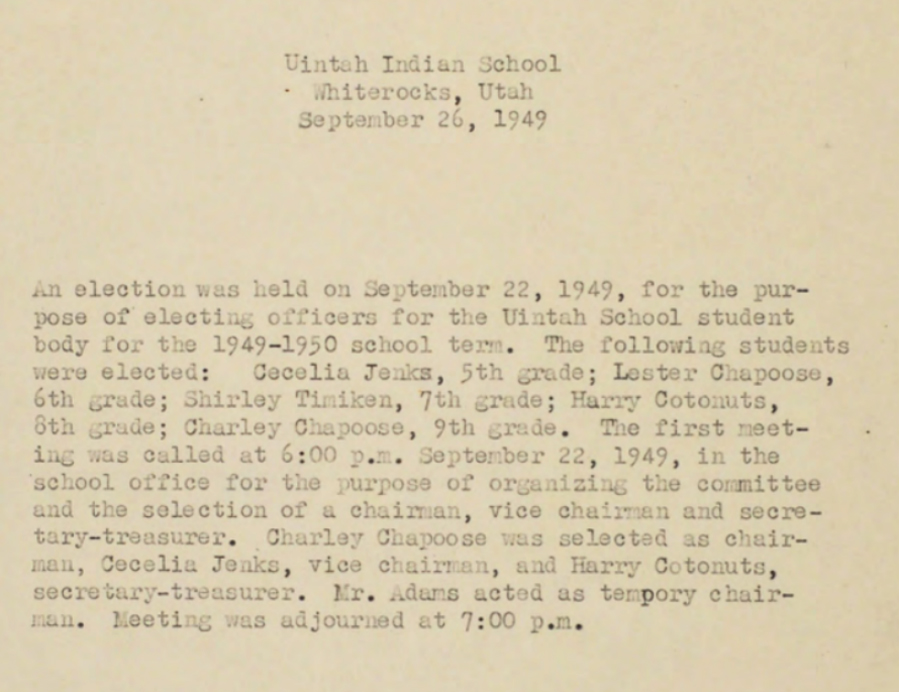
Yellowed school record
The last page of the document gives the results of the Sept. 22, 1949, election of student body officers.

Popular posts from this blog

The Dispossessed: Cultural Genocide of the Mixed-Blood Utes, an Advocate's Chronicle

PDF DOWNLOAD AUDIO BOOK The Dispossessed: Cultural Genocide of the Mixed-Blood Utes, an Advocate's Chronicle. In this disturbing and provocative study, Salt Lake City attorney Parker M. Nielson chronicles the termination of the mixed-blood Utes from the Northern Ute Indian Tribe. He outlines how the termination process, initiated by Utah Senator Arthur V. Watkins, was visited on the Utes in a singular action by the U.S Congress and the Bureau of Indian Affairs, the only partial termination of any tribe in the nation. Termination for the mixedbloods meant loss of both tribal membership and any further claims upon the Bureau of Indian Affairs, similar to the impact of the termination policy upon other tribes in the 1950s. But for the mixed-blood terminated the losses went much further than being cut off from government assistance. Nielson, with first-hand information gained as legal representative for the terminated Utes, details how the separation of the terminees from tribal member...

Death of Utah Chiefs | Walker, Arapeen, Ammon, Peteetneet, Sanpitch, Kanosh, Tabby, Santaquin, Andrew Frank, Jim Atwine

  Deseret News | 1855-02-08 | Page 3 | Death of Indian Walker Deseret News | 1860-02-08 | Page 4 | Later from San Pete County Deseret News | 1860-12-19 | Page 1 | Death of Arapeen Deseret News | 1861-06-19 | Page 4 | Death of Ammon Deseret News | 1862-01-01 | Page 1 | Death of Peteetneet Deseret News | 1866-04-26 | Page 5 | Whites and Indians Killed Deseret News | 1866-05-10 | Page 5 | Home Items Killing of Sanpitch Deseret News | 1868-12-16 | Page 5  Deseret News | 1881-12-28 | Page 3 | Death of Kanosh Salt Lake Telegram | 1902-10-30 | Page 1 | Fifty Ponies Killed over Grave of Chief Tabby Deseret Evening News | 1902-11-03 | Page 7 | Fort Duchesne Salt Lake Tribune | 1902-11-23 | Page 6 | The Death of Chief Tabby Inter-Mountain Farmer | 1902-11-25 | Page 2 | The Death of Chief Tabby Wasatch Wave | 1902-10-31 | Page 3 | Chief Tabby Dead Spanish Fork Press | 1911-10-26 | Page 2 Roosevelt Standard | 1951-12-20 | Page 2 | Andrew Frank Vernal Express | 1951-12-27 | Page 1 | F...

Termination's Legacy: The Discarded Indians of Utah by R. Warren Metcalf

  Termination's Legacy: The Discarded Indians of Utah [PDF DOWNLOAD] Termination's Legacy: The Discarded Indians of Utah [AUDIO BOOK] Termination's Legacy describes how the federal policy of termination irrevocably affected the lives of a group of mixed-blood Ute Indians who made their home on the Uintah-Ouray Reservation in Utah. Following World War II many Native American communities were strongly encouraged to terminate their status as wards of the federal government and develop greater economic and political power for themselves. During this era, the rights of many Native communities came under siege, and the tribal status of some was terminated. Most of the terminated communities eventually regained tribal status and federal recognition in subsequent decades. But not all did. The mixed-blood Utes fell outside the formal categories of classification by the federal government, they did not meet the essentialist expectations of some officials of the Mormon Church, and th...